Unfrozen · research and free tools for leading change from the middle

What actually works when you lead change from the middle.

Unfrozen is for the managers who carry change. I grade the research by how much weight it can bear, say where it's thin, and turn what holds up into tools you can use on Monday.

Leading a reorganization, a new system rollout or an integration, and losing ground between the plan and the front line? For leaders: get help with a change.

12 questions leaders ask about the managers who carry change, answered.

A free 16-page guide from the Atlas of the Middle, each answer graded by how strong the evidence is.

Change moves through the middle.

Plans come down, news has to go up, and the managers in between carry both. Everything here is built for them.

The Unfrozen Loop, version 0.2

A working model, built from the evidence.

Start with a week-0 baseline, then run five parts on a rhythm, on a culture where it's safe to speak. It isn't tested as a whole yet, and each part lists what's still untested.

Week 0, before you start. Measure where things stand, share it back with the team, and compare against it at every review.

  1. Surface both ways. Bad news travels up as easily as plans travel down.
  2. Make sense together, top included. Teams work out what the change means for their work; the top says what it costs.
  3. Start it close to the work. Running it is the middle's real job: the manager leads the rollout.
  4. Review on a rhythm, then hold the pace. One fix each time, and keep the reviews going.
  5. The middle's own weather. Peer advice, and (a hint so far) support for staff where their manager feels unsupported.

The strongest evidence so far

Four findings that rest on controlled tests.

58 of the 2,367 findings I've graded so far are strong enough to rate High. Three of these four are among them; the fourth, on 911 dispatchers, dropped to Medium after a full read. How I grade · How these counts relate to the Atlas

Review on a rhythm

Debriefs were linked to about 25% better performance.

Across 46 samples, debriefs (after-action reviews) were linked to about 25% better performance on average than comparison groups (d = .67), with similar effects for teams and individuals. Many of the pooled studies were quasi-experimental.

Tannenbaum & Cerasoli, 2013 · meta-analysis · rated High from the full paper

The middle's own weather

Dispatchers prompted to swap advice with peers reported less burnout.

911 dispatchers prompted each week to swap advice with peers in other cities reported less burnout four months later (0.4 standard deviations, among the 152 of 536 who answered the survey), and among those who stayed through the six weeks, resignations fell by more than half.

Linos et al., 2022 · field experiment, 536 dispatchers · rated Medium from the full paper

Start close to the work

Training clinic leaders raised use of the new practice.

In clinics whose leaders got an implementation-leadership program, clinicians viewed the measure's feedback report in 23.1% of sessions on average, against 3.4% in clinics that had training and technical assistance only.

Williams et al., 2024 · randomized trial, 21 clinics · rated High from the full paper

Start close to the work

Aim the strategy at leaders, not only the front line.

A strategy aimed at program leaders raised how faithfully a practice was delivered. A separate strategy aimed at frontline providers had no significant effect on any outcome.

Brookman-Frazee et al., 2025 · randomized trial, 65 programs · rated High from the full paper

Two of these four were run in mental health and school services, so they may not carry over to every workplace.

The course

Leading Change with Evidence

A self-paced online course for managers leading a change from the middle. You work on a live change of your own across 11 modules and 23 measured instructional hours, with the evidence grade shown for each research claim. Every module has an assignment on your own change, and a 40-question final exam closes the course (pass mark 80%).

Finishing earns a certificate of completion stating the instructional hours. It is not a certification. The Change Toolkit is included.

23 hoursof instruction, measured
11modules, on a live change of your own
15Change Toolkit templates, included
Freefirst lesson, Module 0

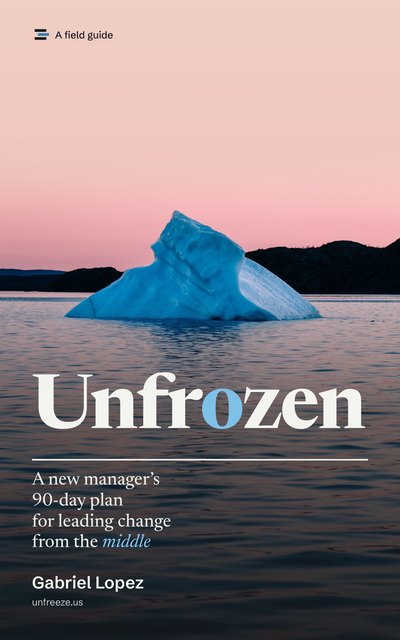
Read Unfrozen.

The Unfrozen newsletter is published on LinkedIn: what the research says about change in the middle of organizations, and what to do with it on Monday. A book for new managers leading change is in the works.

Gabriel Lopez

Who's behind it

I spent eight years in the U.S. Army, where after-action reviews and commander's intent are how work gets done. I did my doctoral coursework in organization development at Benedictine University, and I write Unfrozen, a newsletter on how change actually moves through organizations.

I built the Unfrozen Research Index and the evidence behind this page because I wanted to know what the research really shows about leading change from the middle, and how much of it you can lean on. How often does the research even mention the middle?

  • ServiceU.S. Army, 2008 to 2016, NCO Academy instructor, two deployments to Afghanistan
  • TrainingDoctoral coursework in organization development, Benedictine University. MBA, Webster University.
  • ResearchUnfrozen Research Index: about 35,000 research articles from 29 journals, 2007 to 2026 (2026 to date)
  • LanguagesEnglish and Spanish
  • Contactgabriel@unfreeze.us

I also work with organizations on change from the middle. See how I work.